
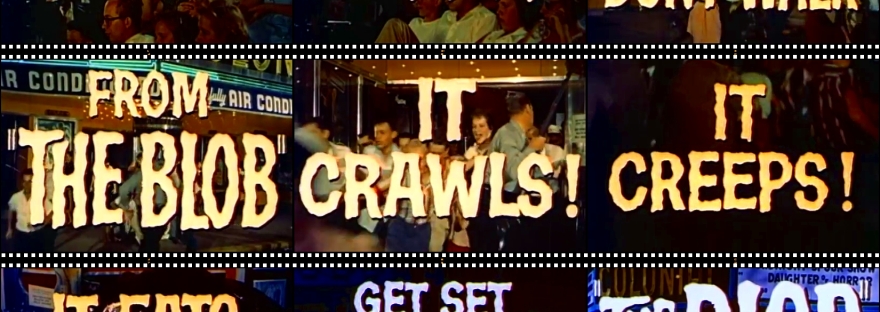
With Halloween just around the corner, I’ve decided to deviate from my typical library and book-related theme. Much to my delight, horror movies have been playing on some TV channels around the clock. I’ve been reading The Amityville Horror, a book which inspired a classic movie and a whole slew of lame sequels. The book, however, just so happens to be based on a true story. A lot of horror movies are based on true stories: The Exorcist, The Texas Chainsaw Massacre, Psycho, The Girl Next Door, The Conjuring… But there’s one movie that’s based on a true story that you wouldn’t expect. This is a real head scratcher. The film is the 1958 B-movie, “The Blob”.
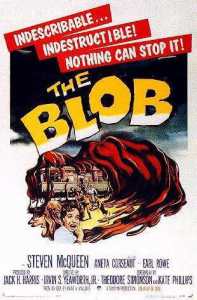
For those of you who have never seen it, the movie is about a a strange “blob” that falls out of outer space, but it doesn’t just sit there. It oozes around, consuming people, and, of course, getting bigger. The movie stars Steve McQueen in his first leading role. This isn’t a review of the movie, so I’ll just link to this trailer for “The Blob”, and you can watch it for yourself if you’re interested, before I tell you the “true” story.
Now, how can a movie about a killer “blob” be based on a true story? Let me tell you…
The story begins in Philadelphia in the year 1950. Two policemen were out on patrol, minding their own business, when a huge purple parachute-shaped globule fell from the sky. They rushed over to investigate.
There’s a lot of inconsistency in articles as to what this “blob” looked like. Some sources said it had crystals, some said it emitted a light mist, but it was definitely purple and it was definitely sticky. How do we know the latter part of that sentence? Of course, the police officer (being highly trained in proper protocols when dealing with unknown and possibly hazardous materials), well, he stuck his hand in it. Fortunately, it wasn’t corrosive or biohazardous, but odorless and seemingly harmless. Although, they never followed up with this police officer. What did he end up dying from? If he died at all? Maybe he’s now immortal…
Two more police officers were called to “investigate”, which probably involved a lot of hemming and hawing and poking and prodding. The FBI was called in, but they were too late. The strange blob disintegrated in twenty-five minutes, which might have been because of all the fondling.
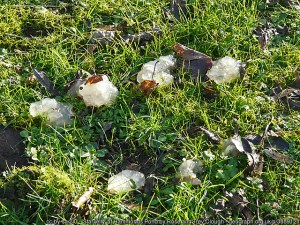
So exactly what was this strange globule? Where did it come from? Given many names across history, including “star jelly”, “star shot”, “astral jelly”, and “fairybutter”, its exact origins are still unknown. It’s shown up in other places, as recently as 2011 in Cumbria, England (Buckland, 2011). In Scotland in 2009, it was reported to show up in smaller globules in farmlands (BBC Scotland Outdoors, 2009).
Historically, there are several accounts of this substance being associated with meteors. As far back as 1619, a man named Robert Fludd saw a “star” fall, and when he went to its landing location, he found a strange gelatinous mass in its place (Belcher & Swale, 1984). Another account from 1910 in Nature tells a nearly identical story. Does this mean the blob really is from outer space?
Strangely, there aren’t many scholarly articles published on this topic. Most of the scholarly material is older, from the 1980s. Experts have apparently provided their input in more recent years, but not in a peer-reviewed manner. Maybe they realize that researching something like this won’t necessarily bring them the prestige they need for tenure. Or maybe this is being researched, but it’s being kept hush hush by NASA, at least until they have definitive proof that it’s alien (not like that time when they falsely believed to have found bacteria that could live off arsenic).
According to Scotland Outdoors of BBC Scotland, Dr. Hans Sluiman, an expert from the Royal Botanic Garden Edinburgh is confident enough to claim that the blob is neither plant nor animal. A fungal expert from the Macaulay Institute identified fungus filaments, but he said they were likely taking advantage of the moist environment, and not a part of the original blob itself. Other experts seem convinced that it’s a type of fungus, likely a species of Tremella, and that the mystery is solved. But this doesn’t explain why its appearance is historically associated with meteor showers. Nieves-Riviera & White (2006) state that while there has been no evidence of fungal spores on meteorites to date, it is a possibility. Essentially, they’re admitting that there is a possibility that this substance came from outer space.
There are no studies that do more than assume that this substance is a fungus. I have yet to find the article that says “Aha! It’s a fungus!” There are some decidedly not scholarly literature that suggests other causes, like rainfall, bird vomit (ew), or dead frogs. They don’t provide much explanation other than the suggestion, so I don’t know enough to discount these theories.
Despite the lack of scholarly scientific literature, there are several interesting papers in the field of ethnomycology. Ethnomycology is defined as “the traditional knowledge and customs of a people concerning fungi” (“Ethnomycology”, n.d.). Ancient astronomical books include reports of this substance following meteor showers. Poems from the sixteenth century associate “falling starre” with “gellie” (Beech, 1993).
While this correlation seems too strong to be a coincidence, we have to look at the facts. Unless scientists are currently studying the origins of this fungus, it is unlikely to be confirmed. Apparently, billions of meteoroids strike the atmosphere every day (Dimant & Oppenheim, 2012). It would be very difficult to determine how frequently they leave behind this residue, especially when it dissolves quickly (the gigantic blob took only twenty-five minutes!), and there might not anyone around to notice. If they do notice, they might not report it. While there seems to be a relationship between meteor showers and the star jelly, it may just be a coincidence. There could be confounding factors that we haven’t even considered. If you’re looking for a relationship, you’ll find one, and everything that happens will support your false beliefs.
Still, I’m not convinced either way. Do you think the blob was space jelly? Or do you think that the fungus came from somewhere else—like rainfall or bird vomit? I can’t tell you one way or the other. But I do know that if that huge purple blob parachuting from the sky was bird vomit, we have an entirely different strange and unexplained problem on our hands.

References:
Beech, M. (1993). The makings of meteor astronomy: Part IV. WGN, 21(4), 200-202.
Belcher, H., & Swale, E. (1984). Catch a Falling Star. Folklore, 95(2), 210–220.
Buckland, B. L. (2011, October 22). The real-life Blob: Is mysterious translucent jelly found in Cumbrian Fells from outer space? Retrieved from http://www.dailymail.co.uk/sciencetech/article-2052189/The-real-life-Blob-Is-mysterious-translucent-jelly-Cambrian-fells-outer-space.html
Dimant, Y. S., & Oppenheim, M. M. (2012). Meteor Plasmas in the E-Region Ionosphere. Presented at the APS Meeting Abstracts. Retrieved from http://adsabs.harvard.edu/abs/2012APS..DPPGM9001D
Ethnomycology. (n.d.). In Oxford Dictionary online. Retrieved from https://en.oxforddictionaries.com/definition/ethnomycology
Inglis-Arkell, E. (2014, August 18). The Blob Was Based On A True Story. Retrieved from https://io9.gizmodo.com/the-true-story-behind-the-blob-162312097
Nieves-Rivera, A. M., & White, D. A. (2006). Ethnomycological notes. II. Meteorites and fungus lore. Mycologist, 20(1), 22–25. https://doi.org/10.1016/j.mycol.2005.11.009
The “jelly” mystery. (2009). BBC Scotland: Scotland Outdoors. Retrieved from http://www.bbc.co.uk/scotland/outdoors/articles/jelly/
“The Blob” by BigdogLHR is licensed under CC BY 2.0
“THE BLOB (1958) trailer” by RE-CUT is licensed under CC BY 2.0

 BibliOccult